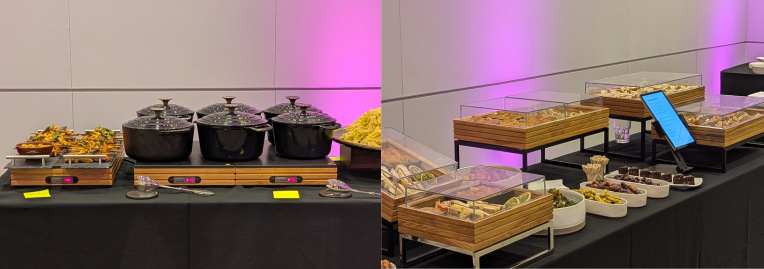
Contract catering has become one of the most exciting growth sectors for us at Craster. While our reputation was built through premium hotels and luxury hospitality projects, we are now seeing rapid expansion in environments beyond the traditional hotel space, especially within the UK and North American markets.
Today, the workplace, leisure, transport and retail dining sectors are investing more heavily than ever in elevated hospitality experiences, and this is where our product ranges, modular systems and collaborative planning tools are proving transformative.
Across global contract catering, we are seeing the strongest adoption of Craster products in three areas:
Financial services, law firms, consulting groups (including Deloitte, EY and others), global tech firms such as Google and Amazon, and large pharmaceutical headquarters are increasingly operating like five-star hotels. Their in-house dining spaces require presentation, flexibility and quality – making our systems a natural fit.
In these environments we deploy our full suite of products:
These projects often scale significantly: 100+ tables for a single corporate location is not unusual.
2. Leisure: stadiums, conference centres & lounges
We have seen remarkable success in large-format leisure venues, particularly in elite football stadiums and arena rebuilds.
Recent examples include:
We also support shopping malls and food halls, providing service flow and waste solutions, Wave trays, distribution trolleys and mobile display systems.
3. Working directly with contract caterers
Alongside workplace clients and leisure venues, we also work with the contract caterers themselves – including Compass, Sodexo, Legends, Aramark, Elior and Levy. These groups manage food service for corporate offices, stadiums, airports and many other environments.
Our role here is to support them when they are bidding for new client contracts, are renewing existing catering agreements, or want to roll out a consistent service style across multiple locations.
To do this, we often run collaborative workshops where we help create standardised set-ups for things like working lunches, coffee points or refreshment stations. We then turn these into simple guides or “look-books” that their teams can use anywhere in the world.
This means caterers can deliver a consistent, high-quality food presentation every time – and their teams can implement Craster products easily, just like a ready-to-use system.
Our strongest advantage in this sector is the ability to help clients see transformation before it happens.
Through PLAN, our space curation and visualisation tool, we can:
Stakeholders can see exactly how a space will function—minimising risk, accelerating approval, and building internal confidence behind large-value investment decisions. When final installations are delivered, the alignment between concept and reality is clear.
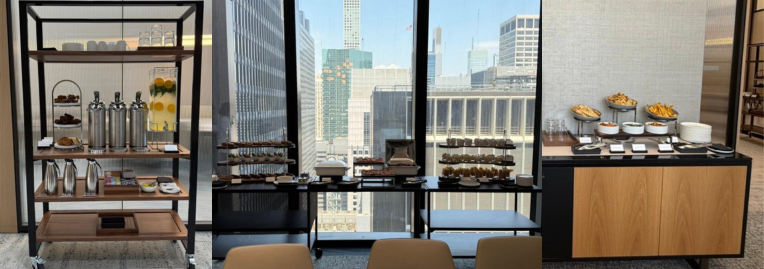
Our recent project at JP Morgan’s new headquarters at 270 Park Avenue, operated by Restaurant Associates, is a powerful example of contract catering at its most forward-thinking. The building, designed by Foster + Partners, is one of New York’s most sustainable new towers and represents a flagship approach to dining where hospitality doesn’t end at the hotel – it lives in the workplace.
For JP Morgan, we delivered:
This project demonstrates how Craster modularity enables full-day transformation: service formats that reset quickly, elevate presentation, and adapt to evolving menus and guest expectations.
Contract catering is not an adjacent market, it is a natural extension of what we do best.
We offer:
• Modular systems designed for all-day transformation
• High-end presentation tailored to non-hotel environments
• Collaborative planning, visualisation and standardisation
• Global support for tenders, multi-site rollouts and design evolution
As workplace and leisure dining expands, we are positioned to lead. We invite our distribution partners and contract catering operators to collaborate with us, share opportunities, and develop new ways to embed Craster hospitality into everyday environments.